

Nobody avoids today’s turbulent business environment. The increase in the input costs of energy and labor resources to the salaries of employees is intensifying, and on the other hand, the subscribers of logistics and transport services are looking for savings and the lowest possible prices of services.
Turn the scissors of costs to your advantage and become better and more competitive
Decision for an efficient IT solution means higher productivity. It enables the company to continue to grow and compete in the market. Modern TMS (Transport Management System) solutions together with algorithms of artificial intelligence and automation of business with customers, employees and subcontractors provide a remarkable increase in business efficiency and transparency of business processes. Technological developments in this area are remarkable. The introduction of appropriate digitalization sets in the business process brings up to 10% savings in the field of long distance logistics and up to 30% savings in the field of last mile logistics. Savings are also significant in (inter) storage and commissioning services. I-Rose, d. o. o., has been present in the information technology market for 30 years. With their products and knowledge, they cooperate with the most successful Slovenian and foreign companies.
Example of a long-distance logistics project
The logistics company with 80 vehicles – towing vehicles, which provides distribution services in the long distance segment, has decided to comprehensively digitize its business. Paper documents have almost disappeared, and portal mode and automatic data exchange integration mechanisms are used to communicate with customers and subscribers. The entire transport planning is performed by 1 dispatcher, and the billing of services is performed by 1 accounting worker. By introducing comprehensive digitalization into their business, they have provided a solid basis for growth at almost the same operating costs of the back office (at the beginning of digitalization, they had less than 40 vehicles). The company’s growth is exceptional, and the investment in digitalization has paid off in less than a year, after the handover of the entire environment. Today, the company is one of the most successful in its segment in the Republic of Slovenia.
Last mile logistics project example
The logistics company with 30 vehicles, which provides distribution services in the logistics segment of the last kilometer, reduced the required fleet of vehicles by 8, from 30 to 22 vehicles, by using artificial intelligence mechanisms in planning and monitoring the implementation of transports. The investment in software and business reorganization of the session paid off in less than a year.
Savings:
- 8 driver salaries
- 8 vehicle depreciation
- 800 kilometers per day
- Shorten delivery planning time from a few hours to a few minutes
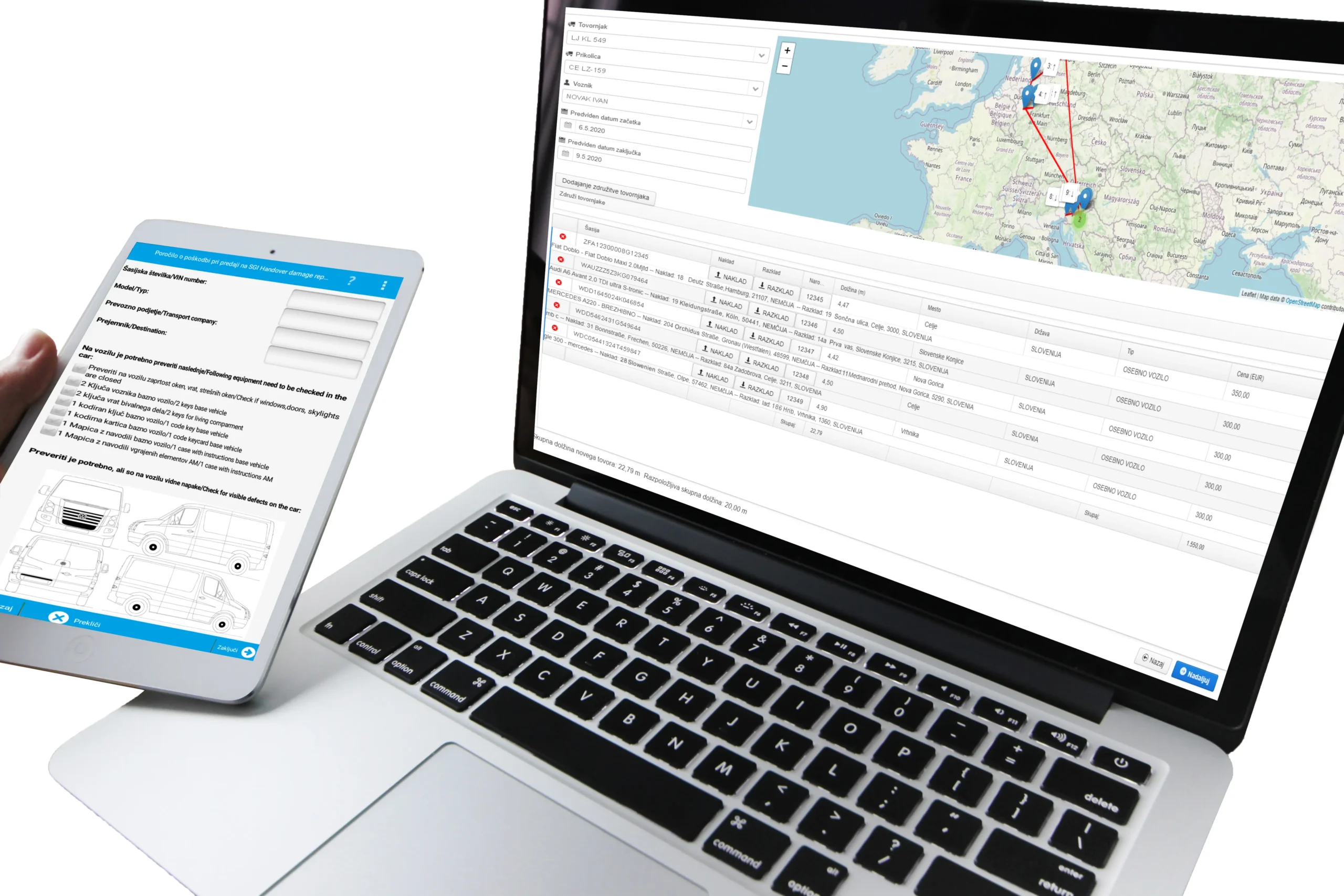
MSP TMS – Transport Management System
- Transport plans, transport planning and inter warehousing
- Treating the fleet as a whole
- Asset repository (transport and other assets)
- Service intervals, referral to a workshop
- Human Resources Repository
- Keeping reminders according to any criteria, warning about the expiration of critical dates (registration, licenses …)
- Digital documentation repository
- Resource utilization rate and resource unavailability
- Monitoring the implementation of plans
- e-POD, electronic delivery note
- e-CMR
- Price lists, contracts, payment deadlines
- Checking credit ratings, blocking customers
- Automatic production of reports (excise duties, accounting documents, transport documents)
- Intermediate storage
- Business history
- Performance analytics ensures the detection of the smallest deviations from the route plan and from the planned costs; monitoring of profitability up to the level of delivery points is ensured. Costs can be monitored close to real time, and employees can be rewarded based on solid and accurate data.
- Profitability calculations
INVOLVEMENT IN TO THE BACKOFFICE AND INTEGRATIONS
- Integration with back-end solutions such as: ERP (financial accounting) and WH (warehouse management), CRM (Customer relationship management), EAM (Asset management)
- D KV, OMV, PETROL
- Excise duties
- Telematics (fuel, tachograph)
- VIES
MSP DIGITAL DRIVER’S JOB
- Fully digitized driver work
- Transport plan (manifest) with all accompanying documentation
- Navigation
- Information on delivery points, pumping stations, rest points
- Barcode recognition, NFC, RFID
- Work with serial numbers and batches
- Circulation control
- ePod, electronic delivery note
- Fiscal cash register
- Capture images and signatures, exact time and geolocation of events
- Download business-related documents (including CMR)
- Alarm when plan changes
- Vehicle condition inspection and entry of detected damages
- Direct communication with the driver (chat)
- Robust asynchronous ANDROID application that works smoothly regardless of internet signal quality
- Multilingual user interface
BONUS / MALUS
- Ongoing recording of praise, achievements, shortcomings and irregularities ensures proper and correct treatment of employees.
- Financial evaluation of rewards and possible penalties.
MSP PORTAL FOR COSTUMERS
- Portals for customers digitize and automate all communication between the contractor and the customer of logistics services, including tracking shipments and changing order parameters. The entry of orders, negotiations on execution, information on executed transactions together with accompanying documentation is automated.
- Repository of past cooperation and supporting documentation.
DIGITAL COMMUNICATION WITH CLIENTS
- Appropriate integration communication interfaces ensure digital communication between the customer and the service provider – orders, shipment tracking and transport documentation are transmitted without human factor.
- Digital path from order acceptance, planning to execution.
MSP SUBCONTRACTOR PORTAL
- The subcontractor portal digitizes the communication between the subcontractor and the actual service provider. Subcontracting is entirely digital.
- Portal support to the subcontractor, allocation of transports to its drivers, monitoring of implementation is provided.
- Accounts and business history.
- Mobile solution for subcontractor drivers.
MSP ROUTE OPTIMIZATION AND CORRIDORING
- Automated route planning and optimization tools reduce transport plan preparation times from a few hours to just a few minutes, while increasing execution efficiency by 30%. Implementation routes are planned to the meter.
- Active warning of deviations from the developed route plan.
- Prevent unnecessary routes (kilometers).
- Automatic learning and improvement of the transport plan based on the performed transports.
- Own virtual road network parameter editing tool.
MSP TRANSPORT EXCHANGE PORTAL
- Upgrading the portal for subcontractors – the internal transport exchange portal ensures competitive dialogue and full transparency of subcontracting.
- A, B, other performers, automatic implementation rounds.
- Determining the terms of the assignment.
- Integration interface for taking over tasks, complete digitization from takeover to execution of the task.
ACTIVE WARNING
- The Active Alert module takes care of the various channels through which participants in the logistics process receive notifications to which they are subscribed (achievement of checkpoints, unloading, circulations, delays in implementation). The tool is fully automated.
- Geo fencing (geographical fences)) automatically warns of the achievement or exceeding of certain points, areas, regardless of business events.
MSP TMS users include companies from different industries that use only parts of the MSP TMS environment or a wide range of functionalities. MSP TMS is used in a wide range of industrial verticals:
- Food industry, distribution of goods,
- Trading companies, organization of deliveries to own warehouses and distribution,
- Forwarders and transport logistics companies with their own fleet, a wide range of practically all functionalities of SMEs,
- Users of external logistics services, integration with TMS interfaces and automation of document flows.
All i-Rose software tools are built in an online environment. They can be used as cloud solutions or installed on your own servers. Information security and easy organization of work from remote locations or work from home is provided.


